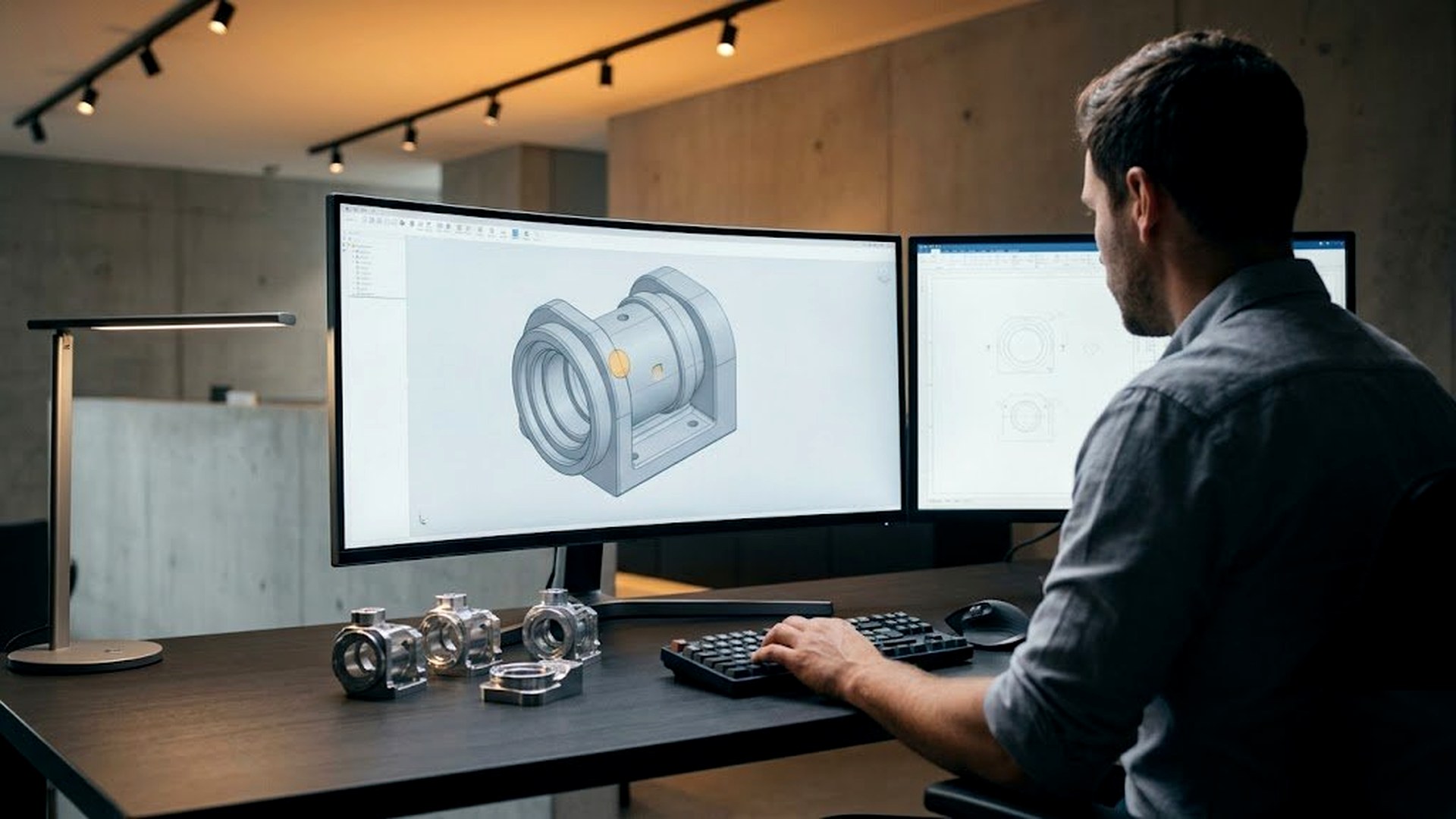
Machines have won. And that consensus has arrived in a place most people didn’t expect: the hardware shop.
There’s a durable assumption that hardware moves slowly because hardware is hard. Atoms behave differently from bits; supply chains move on different clocks than deploys; a bill of materials changes quarterly while a CAD file lives somewhere on an engineer’s desktop. The mental model says software cadence is for software companies.
That assumption is now wrong.
Compute and simulation have, over the past decade, accumulated into something foundational: decades of CAD tooling, parametric simulation, and manufacturing knowledge now sit underneath foundation models, with cloud compute underneath that. The result is that AI can step into the workflow seat across the full hardware lifecycle, from the first drawing to the factory floor. Design, prototyping, manufacturing handoff, component selection: all of it is compressing. Months, not years.
Bee Partners has been building exposure to this shift since 2024 through investments in four companies, each addressing a distinct workflow within the AI-first hardware stack.
Drafter: from 2D drawing to 30 minutes
The design-to-manufacturing handoff is one of the most friction-laden moments in hardware development. A mechanical engineer finishes a 3D CAD model; now someone has to generate the production drawings: 2D documentation, GD&T annotations (Geometric Dimensioning and Tolerancing), and DFM (Design for Manufacturability) notes that a machinist or supplier can actually act on. This step has historically taken days per part. It is painstaking, repetitive, and the source of costly manufacturing errors when it’s done wrong.
Drafter is rebuilding this handoff. The platform integrates directly into CAD environments (SolidWorks, Siemens NX, and STEP files) and automates the generation of production-ready, GD&T-compliant engineering drawings, all while applying industry-level standards. Chris Barton and Peter Atkin started with the most painful, repeatable task at the design-manufacturing boundary and automated it without requiring engineers to change their existing tools.
The clearest signal of what this means in practice comes from a customer at Spaceium. Reza Fetanat, Co-Founder and CTO, put it plainly:
“Drafter is really fast. It helps us move at the speed we need. The seven drawings I made last week would’ve taken me one and a half days. With Drafter, it took 30 minutes.”
That collapse, from a day and a half to thirty minutes, is the software cadence loop arriving at the engineering desk.
Reshape Automation: the automation procurement problem
Most mid-market manufacturers know they need automation. What they lack is a reliable way to find, evaluate, source, and deploy it. The process of connecting a factory floor to an automation solution has been inefficient, lengthy, and unpredictable: a fragmented supplier landscape, long proposal cycles, and no centralized place to manage the project from discovery through to support.
Reshape Automation is building the end-to-end platform for that process. Juan Aparicio Ojea and Carlos Vanegas are approaching this as a systems problem, not a marketplace problem: discovery, design, purchasing, and post-deployment support in a single workflow. The company’s framing is direct. Today, 73 million PCs are sold annually, but only 44,000 robots were purchased across all of North America in 2023. The friction sits in procurement and deployment, and Reshape is removing it.
C-Infinity: assembly planning from the whole down
Traditional mechanical design works bottom-up. An engineer designs a part, then designs the assembly around it. The result is that assemblies are often optimized for individual components rather than for the manufacturing process that has to build them. DFM analysis arrives late, after design decisions have already calcified. Fixes are expensive.
C-Infinity inverts this. AIDA, their AI Design Assistant, is geometry-aware: it analyzes full assembly workflows rather than isolated components. The platform looks at the complete mechanical assembly, then optimizes for part count reduction, manufacturing streamlining, maintenance, and usability simultaneously. Sai Nelaturi, Johan de Kleer, and Mats Bergstrom bring deep research backgrounds to a problem that has been worked on in academic and industrial settings for decades without a satisfying software solution.
The shift is from bottom-up assembly design to top-down assembly planning. In an AI-first stack, the geometry is legible to the model in a way that enables this kind of whole-system reasoning. The design can be evaluated for manufacturability before a single part is committed to tooling.
Zenode: natural language into the bill of materials
Electronic component selection is a research task that sits at the beginning of every hardware product’s life. An engineer needs to find a component that meets a set of electrical and mechanical specifications, confirm it’s available in the right quantities, evaluate alternatives, and integrate that choice into the design. The traditional workflow involves navigating distributor catalogs, reading datasheets manually, and cross-referencing availability and pricing across multiple sources.
Zenode replaces that workflow with an AI-powered search engine that accepts natural language queries, applies parametric filtering, and returns ranked results with real-time availability data. Brandon Bourn and Collin Stoner have framed this as the first step toward AI-powered electronic design automation: once natural language is the interface for component search, the path toward AI-assisted schematic design and procurement opens.
The electronic component search problem sits at the earliest stage of the hardware lifecycle. It’s also among the most underestimated in terms of time cost: hours of research that compound across every project, every engineer, every revision cycle. Zenode is compressing that, and positioning for what comes next.
The lifecycle, redesigned
Laid end to end, these four companies describe a coherent picture: an engineer queries for a component in natural language (Zenode), designs the assembly with AI-driven whole-system analysis (C-Infinity), generates production-ready drawings in minutes rather than days (Drafter), and sources and deploys factory automation through a single workflow platform (Reshape).
No one company solves the full lifecycle. Each solves a distinct workflow slice. But the common thread is that AI is now sitting in seats that used to require expensive, time-consuming human coordination: across design tools, supplier networks, assembly planning, and component databases.
Hardware took years because every handoff was a bottleneck. Bee invested before the market framed this as a category, because the bottlenecks were already dissolving.
That is Future #3.