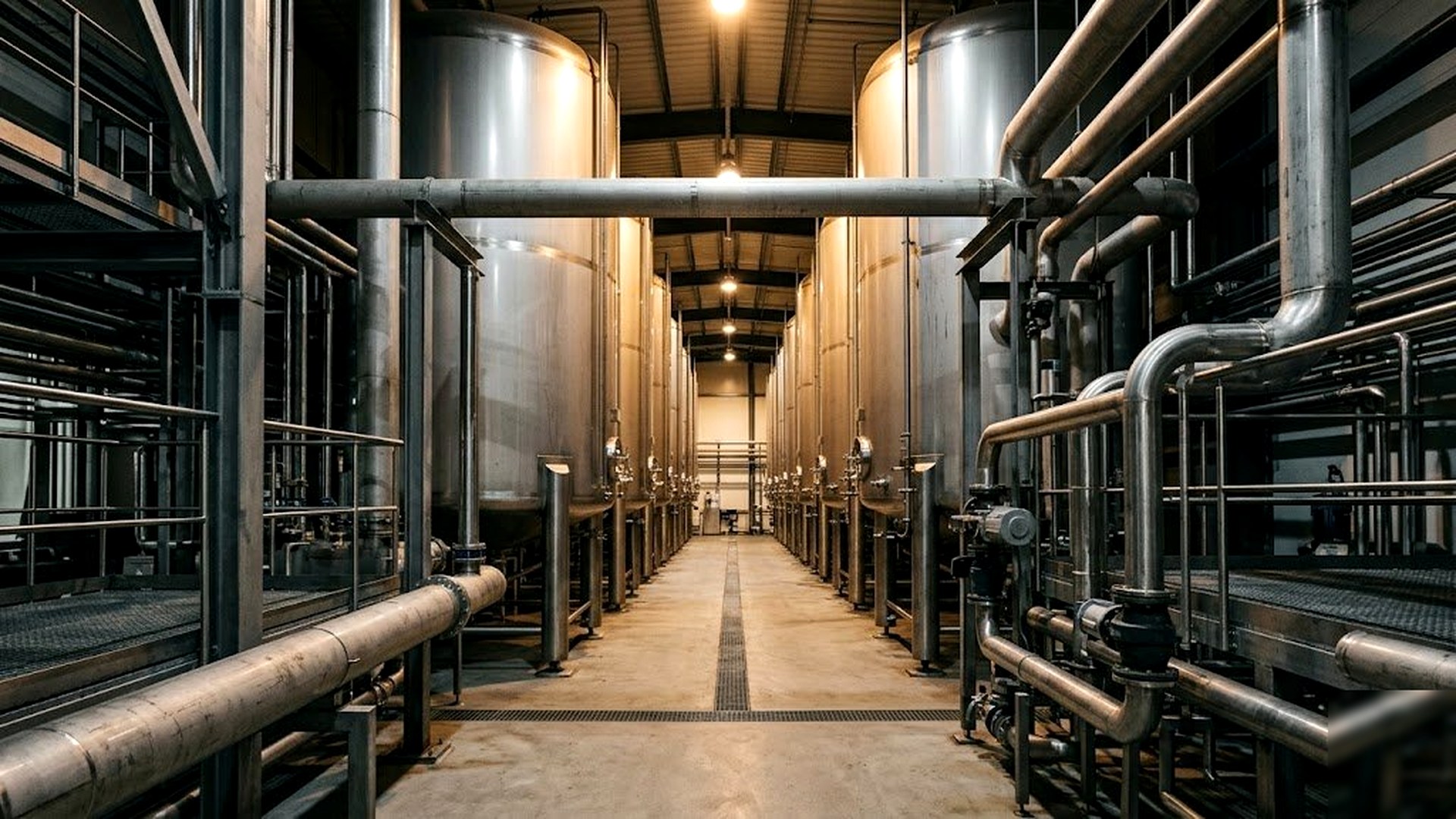
In fall 2025, Pow.bio scaled its continuous fermentation platform to 3,000 liters at ATV Technologies’ facility in Compiègne, France. The process ran in under 10 weeks. It produced three times the protein output of an equivalent fed-batch process and cut projected unit costs by more than 50%. In December, Bühler joined forces with Pow.bio to launch an integrated commercial platform. Customer onboarding is open!
This is what Bee has been waiting to write about.
The bottleneck was never the biology
Precision fermentation has been technically proven for years. The barrier has always been infrastructure: the time, capital, and specialized expertise required to move a validated process from lab to industrial scale. Most companies attempting that move assemble the stack themselves, one vendor at a time, over a timeline measured in years.
What Pow.bio built is different. Its ML controller, Cassie, adapts autonomously to existing hardware. At ATV’s Compiègne facility, Cassie didn’t require custom reprogramming to match the site. It analyzed the environment, adapted in real time, and drove the process outcomes. The same platform that runs in Alameda ran in France, in a facility Pow.bio had never operated before, and hit the numbers.
That transferability is load-bearing. It means the technology is deployable, not just demonstrable.
What the Bühler partnership changes
Bühler brings 165 years of engineering and commissioning expertise to food, feed, and ingredients processing. It has the equipment, the global footprint, and the operational knowledge to qualify sites, manage scale-up, and support production runs across geographies. Before the November ATV milestone, Bühler conducted a comprehensive pre-qualification of the Compiègne site: structural readiness, infrastructure adaptation, technology transfer support.
The November result was proof. The December commercial partnership was its consequence.
Together, Pow.bio and Bühler are offering what the market hasn’t had before: an integrated system where customers don’t assemble the fermentation stack themselves. The process IP, the ML control layer, the engineering and deployment capacity: one package. Co-Founder and CEO of Pow.bio Shannon Hall put it directly in the December announcement:
“Clients can now capitalize on proven technology and global deployment expertise to unlock commercial-scale production with lower risk and unprecedented efficiency.”
From Bühler’s side, Thierry Duvanel, Director of Innovation at Bühler Group, described the direction plainly:
“By joining forces with Pow.Bio, we take a clear step toward reducing unit production costs in biomanufacturing.”
The platform targets companies producing enzymes, functional proteins, specialty lipids, bioactive compounds, and other fermentation-derived ingredients. The market for those products is massive.
Why this matters to Bee
Bee has been building exposure to founders compressing the design-to-manufacture cycle: the future of manufacturing we’ve been writing about is one where speed and software intelligence collapse timelines that used to be measured in years. Pow.bio represents that thesis in biology. The compression here is not in hardware design; it is in the industrialization of biological processes. Our Biological Machines thesis has long argued biology is an engineerable substrate; Pow.bio at ATV is what that looks like at industrial scale. The dynamic is the same.
We invested in Pow.bio before this milestone. We believed then that continuous fermentation would become the standard for industrial biomanufacturing, and that the team Shannon has built had the combination of process expertise, software depth, and commercial instinct to lead that transition. The ATV scale-up and the Bühler partnership are the clearest external validation of that belief we have seen.
Synthesis Capital led the financing; Bee participated. They called Pow.bio’s platform “a critical enabling technology to drive the commercialisation and adoption of alternative proteins and other biobased products.” That framing is consistent with what we saw at entry.
What comes next
The December announcement opened customer onboarding. Bühler’s existing relationships span food, feed, and ingredients processors globally. Pow.bio has the technical platform and the industrial proof point. The question now is how quickly the pipeline converts.
The ATV result answers the hardest question: does this work at scale, in a partner facility, without bespoke engineering? It does. The 3,000-liter milestone in Compiègne wasn’t a controlled demonstration. It was a commercial-readiness test run at a contract manufacturing organization Pow.bio had never worked with before, using Cassie’s autonomous process adaptation to navigate facility-specific conditions.
That is what “industrial scale” means in practice: repeatable, transferable, deployable.
Congratulations to Shannon, Ouwei, and the team at Pow.bio; to the team at Bühler; and to ATV Technologies for making the Compiègne result possible.